#1
地点 London
Advances in the care of patients with prostate cancer across the disease spectrum have resulted in substantial survival gains over recent decades. However, global disparities in prostate cancer survival, stage at diagnosis, and access to timely diagnosis and treatment remain among the greatest across all malignancies. We aimed to quantify country-level health system correlates of the prostate cancer mortality-to-incidence ratio (MIR).
Methods
We applied interpretable machine learning using Cat
展开查看正文
Advances in the care of patients with prostate cancer across the disease spectrum have resulted in substantial survival gains over recent decades. However, global disparities in prostate cancer survival, stage at diagnosis, and access to timely diagnosis and treatment remain among the greatest across all malignancies. We aimed to quantify country-level health system correlates of the prostate cancer mortality-to-incidence ratio (MIR).
Methods
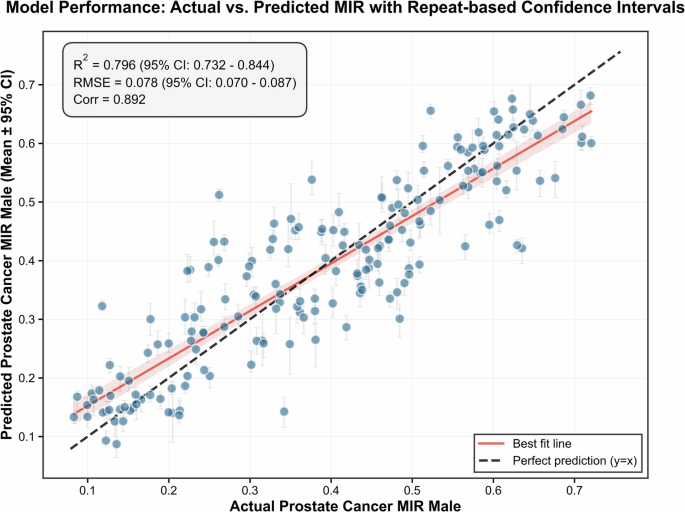
We applied interpretable machine learning using CatBoost with SHAP (SHapley Additive exPlanations) to all 185 countries with prostate cancer MIR estimates in GLOBOCAN 2022. National age-standardized MIR estimates were linked to 11 health system indicators from the World Health Organization Global Health Observatory, World Bank World Development Indicators, United Nations agencies, and the Directory of Radiotherapy Centres. Model performance was evaluated using repeated leave-one-country-out cross-validation with bootstrap-based uncertainty estimation. CatBoost handled missing predictor values natively, allowing inclusion of all countries without imputation.
Results
The model demonstrated strong predictive performance for prostate cancer MIR (R² = 0.80, RMSE = 0.078, MAE = 0.060, Pearson correlation = 0.89). The health system features most strongly associated with lower MIR were gross domestic product per capita, the universal health coverage (UHC) service coverage index, and radiotherapy infrastructure. Country-level SHAP decompositions demonstrated heterogeneous feature contributions across settings, identifying context-specific priorities. Greater radiotherapy capacity and more comprehensive UHC were consistently associated with lower MIR, whereas higher aggregate health expenditure alone showed weaker associations with improved outcomes.
Conclusions
Interpretable machine learning identified radiotherapy infrastructure, universal health coverage, and national wealth as the health system features most consistently associated with lower prostate cancer mortality-to-incidence ratios across countries. These findings suggest that targeted investment in treatment capacity and service coverage may have greater relevance to prostate cancer outcomes than increases in aggregate health spending alone. Although ecological and hypothesis-generating, this framework may inform future health systems research, prospective evaluation, and global prostate cancer control.
#2

地点 United Kingdom
I'm a bowel cancer doctor on the front lines of the crisis and I'm so frustrated by claims there aren't any warning signs. This is the genetic quirk thousands don't realise they have... and how aspirin could cut your risk
Delivering a cancer diagnosis to a patient is never easy.
But it's particularly dreadful when the news is especially shocking given a previous clean bill of health.
Sadly, this is the case for increasing numbers of my bowel cancer patients. They are young, otherwise perfectl
展开查看正文
I'm a bowel cancer doctor on the front lines of the crisis and I'm so frustrated by claims there aren't any warning signs. This is the genetic quirk thousands don't realise they have... and how aspirin could cut your risk
Delivering a cancer diagnosis to a patient is never easy.
But it's particularly dreadful when the news is especially shocking given a previous clean bill of health.
Sadly, this is the case for increasing numbers of my bowel cancer patients. They are young, otherwise perfectly fit, juggling busy working days with young children and often suffering virtually no symptoms.
'Why did this happen to me?' they ask.
For many, the answer remains a mystery; with researchers racing to uncover exactly what it is in our modern environment that's fuelling gut tumours.
But my biggest frustration is that, for thousands, there is a clear culprit. The problem is many don't find out about it until it's too late.
It's especially tragic as there's a simple daily pill that could, in these patients, stop the cancer growing in the first place.
Around 175,000 people in the UK have what's known as Lynch syndrome; a DNA quirk that puts the lifetime risk of bowel cancer between 30 and 80 per cent, depending on the specific gene that's faulty.
James Van Der Beek, star of Dawson's Creek, died from bowel cancer in February aged 48
Women with the problem - which has no symptoms - also have between a 40 and 60 per cent chance of womb cancer. These cancers usually strike before the age of 50.
Crucially, only around 5 per cent of carriers know they have it.
Bowel cancer doctors like me have long attempted to publicise the simple genetic test available via a GP referral that can give you an answer in days.
If you're positive, there's cheap-as-chips preventative treatment: aspirin.
Studies have shown that taking daily aspirin for at least two years can cut the risk of developing bowel cancer by around 50 per cent.
The blood-thinning pill - taken by around 2million Britons - is most commonly used to reduce the risk of clots in those vulnerable to heart attacks.
But research shows that the tablets can also block an enzyme that promotes the growth of bowel tumours in Lynch patients.
The drug also helps the immune system's fighter cells to spot and destroy the cancer.
The clue that you might have Lynch syndrome is if at least one member of your immediate family like a parent, sibling or child, developed bowel, womb, bladder, urinary tract or prostate cancer under 50.
If you have a parent or sibling with Lynch syndrome, you have a 50 per cent chance of inheriting it.
Often a person with cancer will be screened for it and their close relatives alerted and offered a test, but this isn't always the case.
Sometimes a patient may have died before a test was performed, or the results not communicated to loved-ones.
In these cases, their relative may be eligible for a DNA test from a local specialist centre, as well as genetic counselling where doctors may recommend regular colonoscopies as well as a daily aspirin.
Unfortunately, it is somewhat of a postcode lottery; some local NHS bosses will fund Lynch syndrome tests in those with one affected relative, while others will require three.
It all means that too few people know that Lynch syndrome exists; and a very small number get the crucial genetic testing.
There are private tests available, however, costing anywhere between £500 and £1500. Steer clear of the at-home tests - you need a specialist to take you through the results.
There's another subset of patients who may also benefit from aspirin. But, frustratingly, whether or not they can access it is another postcode lottery.
This problem concerns around a third of bowel cancer patients - those whose tumours have a genetic mutation called PIK3CA.
This quirk acts like a growth switch in cancer cells, telling them to multiply and survive.
Last September, Swedish researchers published the results of a major trial that showed taking a daily aspirin for three years could halve the risk of these cancers returning.
Dame Deborah James - known as Bowelbabe - lived with the disease for five and a half years before her death aged 40
That's a better result than some types of chemotherapy for earlier stages of the disease, which is offered to many patients.
It's thought that the drug interferes with the genetic signals that fuel the growth of the tumour.
Tragically, the vast majority of NHS bowel cancer patients who are eligible will not be offered it.
The drugs watchdog, the National Institute for Health and Care Excellence (NICE) does not yet recommend it. In practice, barely any of my NHS patients can even access the test that reveals if they have a PIK3CA mutation.
Privately, however, it's a different story. I saw this injustice play out in the treatment of two of my most recent patients.
I recently saw Mark, a 36-year-old father-of-two, diagnosed with stage three bowel cancer (that spread to his lymph nodes), in my NHS clinic.
He is sporty, slim and otherwise perfectly fit, and, having undergone surgery, was desperate to know everything he could do to stop the disease coming back - which happens in around a third of cases.
I had no choice but to tell him chemotherapy and exercise were the only interventions available. I wrote to his local genetic specialist clinic, asking if they'd test him, but my request was rejected.
Meanwhile, Jonathan, a 35-year-old, similarly fit patient who I see in my private clinic, was tested, and received a prescription for aspirin within a few weeks - no questions asked.
It's important to flag that the side effects from aspirin can be serious - such as severe bleeding, bruising and gut pain.
Your browser does not support iframes.
This is why the genetic tests are so crucial. We should only offer the treatment to those who need it.
There is reason for hope. Colleagues tell me that, in a handful of areas, local NHS bodies are beginning to fund the PIK3CA test, such as areas of Cambridgeshire.
But the NHS has seven genetic testing centres across the UK - called genomic laboratory hubs - all of which can easily tell patients in any part of the country if they're a candidate for aspirin.
Aside from informing treatment, genetic details may also hold clues to the mystery of increasing young Britons being hit with bowel cancer - with cases in under-50s having risen by 50 per cent since the mid-Nineties.
Celebrities including Dame Deborah James, the campaigner known as Bowelbabe who was diagnosed with bowel cancer at 35, and Dawson's Creek star James Van Der Beek, who died this February aged 48, have put the disease in the spotlight. Both urged the public to take symptoms seriously and to get checked early.
Researchers have identified that patients under 50 are far more likely to harbour tumours with genetic changes such as PIK3CA that develop over time as opposed to being inherited.
This suggests that exposure to some sort of environmental trigger is causing cancerous changes in their DNA - perhaps early in childhood.
But exactly what these triggers are is yet to be confirmed.
Some convincing evidence suggests diets high in ultraprocessed food lead to 'hidden' visceral fat around our organs. This is said to interfere with the DNA in our digestive cells, driving cancer. Or, some say, poor diets trigger cancer-causing changes to the healthy bacteria in our guts.
Other studies meanwhile argue that the microscopic plastics we absorb in everyday life - or even polluted air - could be to blame.
We won't have solid answers for at least another few years.
In the meantime, I hope NHS bosses will grant all patients access to every test and treatment that could help.
With cases rising as they are, doctors like me are going to need as much help as we can get.